
A quieter way through credit card debt
The one safe thing to do with your money today.
Advizel tells you the one amount that's actually safe to send toward your debt.
Email support@advizel.com and I'll add you by hand.
Connecting is free — I'll never charge without asking.
Android today. An iPhone version is in the works.
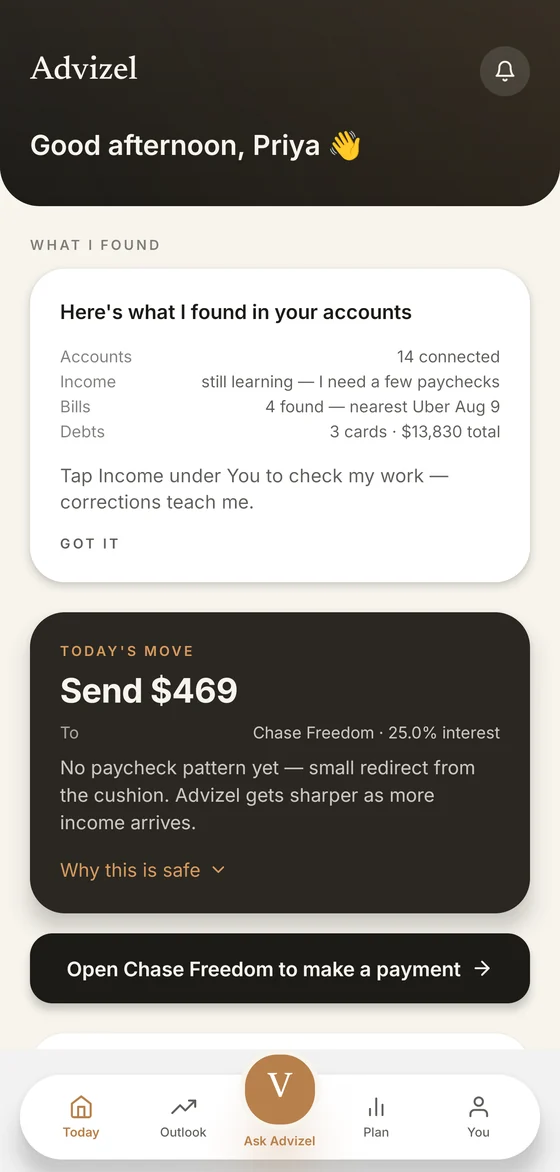
- One number a day
- From your real accounts
- The full math behind it
- Read-only, always
The proof
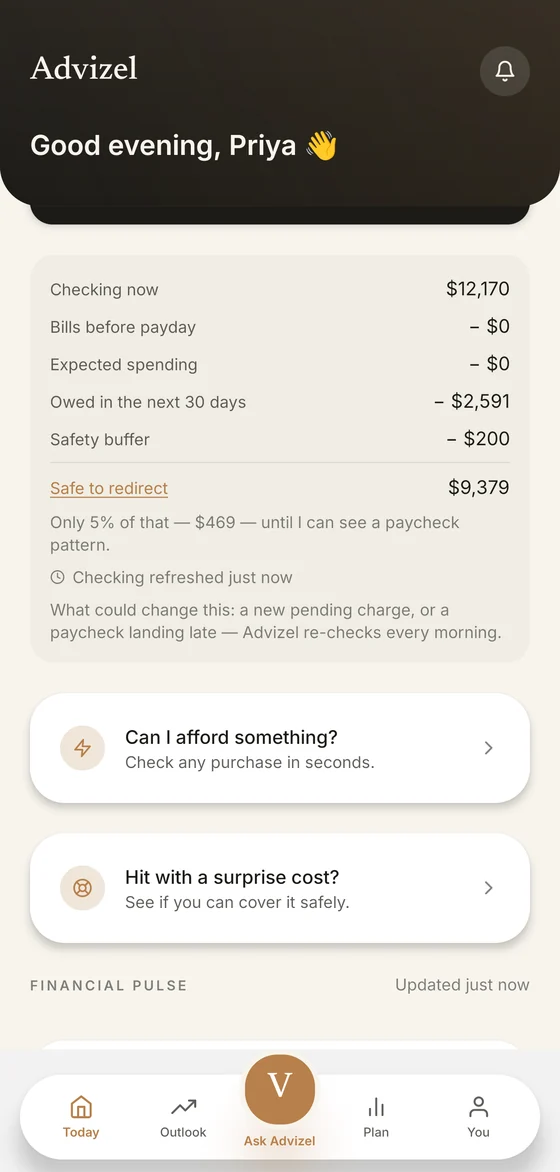
It shows the math.
One number, recalculated daily from your real cash — not a static budget.
What makes it different
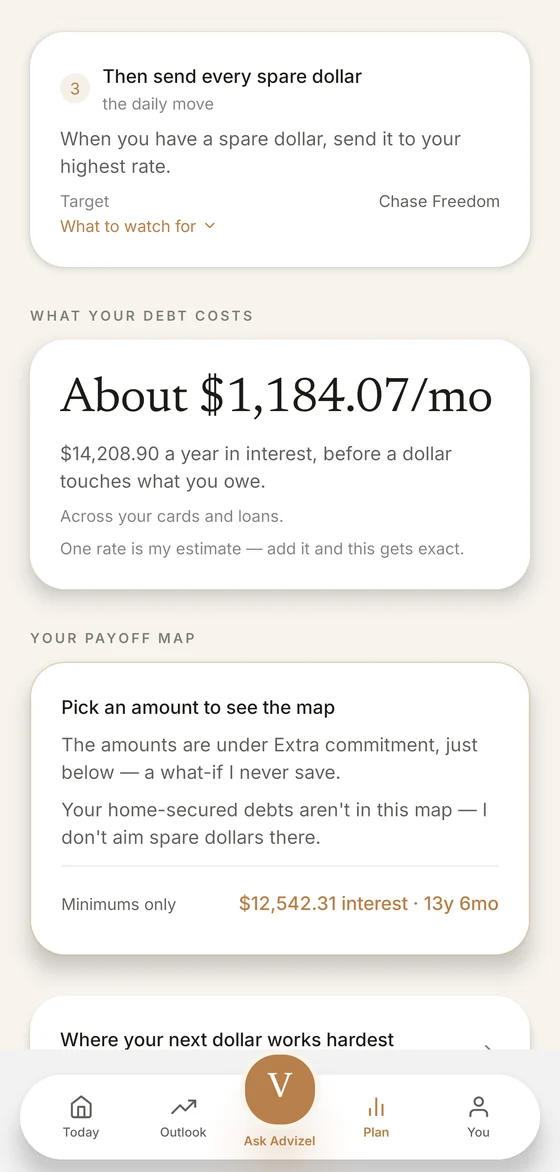
The house stays out of it.
Moving spare cash into home equity is close to irreversible.
How it works
Three steps, then it runs itself.
- Connect your accounts — or add them yourself
- See today's one safe move, and the math
- Follow the plan, one day at a time
Your data
It can't move your money. That's architecture, not a promise.
- Bank connection
- Plaid, read-only
- Your bank login
- Never stored by Advizel
- Data in transit and at rest
- Encrypted
- Street address, SSN, government ID
- Not collected
- Ads, lead-gen, data sales
- None, ever
- Export and delete your data
- Any time, from Profile
Prefer not to connect? Add your accounts and debts by hand.
What's in it
The rest of what it does.
- 30 days ahead, not 30 days behind
- Your projected daily balance, and the tight days
- A real attack order
- Avalanche or snowball, with the real cost
- It says what it doesn't know
- A plain list of the gaps
- Word-for-word, for the phone call
- An exact script for your issuer
- Ask it anything about your own numbers
- Answers over your real data
What it costs
One price. Paid by you, so it answers to you.
$14.99 a month
or save with a yearly plan
The example account above is paying about $1,184 a month in interest.
- Cancel
- Any time
- After you cancel
- Access runs to the end of the period
No free tier and no trial.
Questions
The things people actually ask.
Is my bank data safe?
Advizel is read-only — there's no code path in the app that can move your money. You can connect a bank through Plaid or skip that and add accounts by hand. There's no advertising and nothing here sells your data.
Is this just another budgeting app?
No categories to sort, no zero-based budget to maintain. Advizel computes one number for you, every day, from your real accounts.
Why this is safe
From what's in checking, what's due before your next paycheck, and a buffer left on purpose. Open Why this is safe any time and every line that built it is there — plus what could change it, and when it last looked at your accounts.
Will using this hurt my credit?
Advizel never applies for credit or checks your credit on your behalf. The one honest caveat: asking your card issuer for a lower rate doesn't itself trigger a credit check, but if they review your account as part of that call, they can adjust your limit — which can move your utilization.
Why not just use a spreadsheet?
If you're the kind of person who checks a payoff calculator's arithmetic by hand, this is built to survive that. Every figure comes from one calculation engine, independently re-derived from scratch against thousands of scenarios, to the cent — and it updates itself from your real transactions every day instead of going stale.
Considering a balance transfer?
Advizel separates what paying more each month buys you for free from what the transfer's 0% rate buys on top of that — so you know what you're actually paying a fee for.
What if I freelance or take 1099 income?
Advizel sets aside an estimate for quarterly taxes as gig income comes in, so the number isn't a surprise later — a rule of thumb your CPA can tune, not a filing.
Will this tell me to raid my equity?
No. Home-secured debt is deliberately excluded from the payoff plan, and the app says so on screen. That's not a call an app should make for you.
Does this work with my bank?
Advizel connects through Plaid, which supports most U.S. banks and credit unions. If your institution isn't supported, or you'd rather not connect at all, you can add accounts and debts by hand.
Is Advizel a financial adviser?
No. It gives general information based on your own data, not personalized financial, tax, or legal advice, and it's not a registered investment adviser, CPA, law firm, or credit-counselling agency.
What if a debt is in collections?
Advizel doesn't currently have guidance for a debt that's in collections or past your state's statute of limitations — paying on one, even partially, can restart the clock in some states. If that's your situation, talk to a nonprofit credit counselor (nfcc.org) before making a payment.
Is there an iPhone app?
Advizel runs on Android today. An iPhone version is in the works — this page will say so plainly when it's ready, and not before.
See your one number.
Email support@advizel.com and I'll add you by hand.
Connecting is free — I'll never charge without asking.